
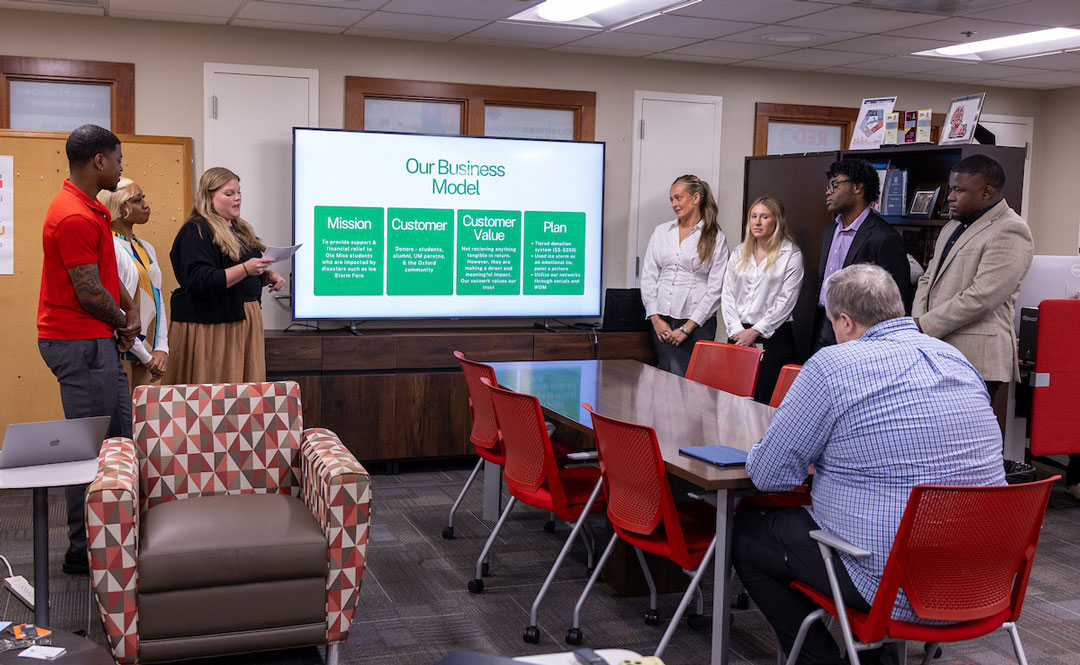
At the University of Mississippi, a group of MBA students proved that business education can be as much about empathy and impact as spreadsheets and strategy — and they raised thousands of dollars along the way.
In MBA 622: Business Planning and Entrepreneurship, students designed and led fundraising campaigns for the Rebel Relief Disaster Fund, the Ole Miss Opportunity Scholarship and Grove Grocery, the campus food pantry. The projects emphasized clear messaging, personal outreach and accountability to donors.
The course was taught by Clay Dibrell, chair of entrepreneurial excellence, co-director of the Center for Innovation and Entrepreneurship and professor of management.
“The idea is the application of both analytical and social skills to sell,” Dibrell said. “Many of these students may be a little bit introverted, but it allows them to see the power of interaction.
“The most exciting thing was to see them figure it out. They chose a project, and they either do well, or they must figure it out when they don’t.”
Students worked with Annual Giving in the UM Office of Development, which provided technical support and hosted campaigns on the Ignite online giving platform, while students managed outreach, messaging and donor engagement. Since 2016, MBA students have launched more than 20 projects, generating nearly $48,000 from more than 1,300 gifts.
This year, each group met its goal of $1,800 for its cause.
Rachel Sanders, assistant director of Annual Giving, said her office’s goal is to make a difference, no matter how big or small. The project accomplished that.
“Teaching students specifically about giving is important because you can often think your money goes nowhere, or that you have to give thousands of dollars to make a difference,” Sanders said. “This project always shows students that giving as little as $5 makes a difference no matter where you give.”
The program also helps students identify true needs on campus.
“It's always fun watching these students come up with new strategies for getting donations, because they always think of new, fun ways, which can be hard to do,” Sanders added.
Grove Grocery
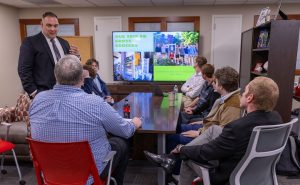
Students raising funds for Grove Grocery emphasized personal outreach and service. Jarrid Moore of Cotton Plant, Mississippi, believes the experience reinforces UM’s commitment to helping others.
“Ole Miss is serious about lifting others up, and it’s a point of pride for all,” Moore said.
Jake Warren of Sacramento, California, saw donors respond quickly once they understood the mission.
“I just think that really shows the culture here at Ole Miss: people are willing to give; they just need to be aware of the need and how they can make an impact,” Warren said. “I am very grateful that we were able to help bring that awareness to others.”
Ole Miss Opportunity Scholarship
Another team focused on the Ole Miss Opportunity Scholarship, a need-based award. Chloe Payne of Dallas, Texas, recognized that donors connect most with clear, personal messaging.
“We saw that people have strong emotional ties to Ole Miss, especially when they feel like their gift is directly helping students,” Payne said. “A lot of donors connected with the OMO Scholarship because it felt personal and tangible.”
For Ava Scaglione of St. Louis, Missouri, the project highlighted the importance of promotion.
“I think I was amazed by how far our reach was,” she said. “The lesson learned is to market heavily.”
Rebel Relief Disaster Fund
One team exceeded its goal by sharing stories of students affected by January’s winter storm. Omobola Obasanjo of Greenwood, Mississippi, believes personal connections made the difference.
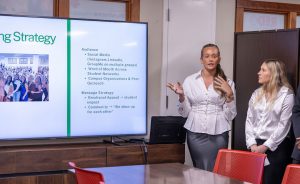
“Storytelling drives action,” Obasanjo said. “A lot of the donors were people who cared, but also people who cared about us. Community was our biggest helper.”
Kennedy Burkhall, an MBA student from Mineral Wells, Texas, praised social media and group messaging for quickly building awareness.
“Really the members of any group chat who received the message would either read about it, make a gift or forward the message along,” Burkhall said.
The strategy was simple, but effective.
“We pulled in the emotional appeal with everyone,” Burkhall said. “Because it was something so recent and so many people were affected by it directly, it was easy to reach the Ole Miss community. We show up for each other.”
To support students and programs at the University of Mississippi, visit here.
For more information on supporting the Business School, contact Angela Brown, executive director of development, at browna@olemiss.edu or 662-915-3181.
By Michael Newsom/UM Development