

A $275,000 investment from the Carnegie Foundation for the Advancement of Teaching supported a recent national summit designed to prepare educators to use improvement science to benefit their students.
The National Center for School-University Partnerships (NCSUP), housed in the University of Mississippi School of Education, hosted the two-day East Coast Improvement in Education Summit, bringing together over 300 K-12 teachers, college-level faculty and administrators from around the world.
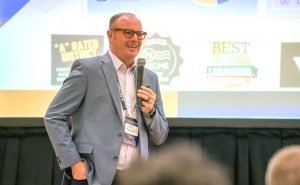
“This year’s summit was an amazing opportunity to collaborate, share and learn about successful improvement practices happening across the country,” said David Rock, the dean of the School of Education and founder of the NCSUP, which was created to ensure ongoing collaboration between K-12 school districts and universities.
“Through working together, we can improve student outcomes and tackle complex issues in the field of education, such as the critical teacher shortage,” the dean said.
Mary Bramlett, a UM academic counselor and NCSUP program manager, helped plan the Nov. 6-7 summit — “Where Partnerships Drive Progress, Applying Improvement Science Together” — at the Gaylord Opryland Resort and Convention Center in Nashville, Tennessee.
Tim Knowles, president of the Carnegie Foundation for the Advancement of Teaching, said the foundation’s confidence in the dean’s vision and leadership was the driving force behind its investment.
“The University of Mississippi School of Education is a pathfinder, bringing together scholars, practitioners and policy makers in essential ways, to improve public school systems nationwide,” Knowles said.
“Further, its National Center for School-University Partnerships gathers leading practitioners and scholars to develop, test and scale scientifically based methods for improving public education,” he continued. “We hope the summit can become an important ‘public square’ for this work and, in so doing, forge new partnerships, build knowledge and address the major educational challenges of our time.”

Bramlett said she and the dean are grateful to the Carnegie Foundation for making the event possible.
“We both truly value the work that the Carnegie Foundation for the Advancement of Teaching has done and the work that was pioneered by that organization all those years ago,” she said. “If it were not for their leadership, none of this would be here in terms of improvement science and its integration into education.”
Improvement science equips educators with the tools to solve complex problems in the classroom. At the summit, attendees learned innovative methods to integrate improvement science into existing coursework.
“If educators can learn problem-solving skills early on, teachers are more likely to remain in the field of K-12 education beyond five years,” Bramlett said.
Bramlett said the Carnegie Foundation’s investment enabled the summit planning team to secure a venue that was a convenient destination for attendees and cover costs associated with promoting the event.
Additionally, “the Carnegie investment allowed us the flexibility to be able to focus on the content that we were teaching and gave us the opportunity to make sure that we were providing meaningful content to our attendees — really concentrating on what our mission is, which is improving student outcomes,” Bramlett said.
“By not having to worry about the financial constraints as much, we were able to prioritize what we could do to make the summit a good experience for our attendees and ensure they came away with the most knowledge available to improve the students that they’re serving.”

In addition to the summit attendees, who had the opportunity to connect and collaborate with other organizations experiencing the challenge of teacher shortages, the NCSUP brings together school districts and universities throughout the year to address problems of practice.
“For example, over the past year, we’ve addressed chronic absenteeism and improving special education math proficiency in the state of Mississippi,” said Bramlett, who facilitated the meetings alongside Dean Rock. “For our Mississippi partners, that’s been really significant and beneficial.”
Knowles said he’s eager to see the NCSUP’s work continue to benefit educators for years to come: “We hope our investment in the University of Mississippi will lead to richer, stronger, impact-focused partnerships between the academy and school systems and, in so doing, establish a model for other universities dedicated to strengthening the nation’s economy, democracy and social fabric.”
For more information about the NCSUP, contact Bramlett at 662-915-5986 or mgbram@olemiss.edu.
To make a gift in support of the UM School of Education, including the NCSUP and/or a future East Coast Improvement in Education Summit, click here or contact Kelly Smith Marion, director of development, at 662-915-2007 or ksmith13@olemiss.edu.
By Bill Dabney/UM Foundation